
In 1770, a Hungarian engineer named Wolfgang von Kempelen unveiled an automaton for Empress
Maria Theresa: a life-sized figure seated behind a wooden cabinet, able to play chess against
a human opponent — and win. The Turk, as it came to be known, toured Europe and America for
decades, reportedly defeating challengers that included Benjamin Franklin and, by some
accounts, Napoleon Bonaparte himself. Audiences were certain they were watching a genuine
thinking machine.
They weren’t. Hidden inside the cabinet, folded into a sliding compartment, was a human chess
master, working the automaton’s arm by a system of levers and watching the board through a
scrim. The Turk wasn’t artificial intelligence. It was theater — brilliant theater, but
theater.
I’ve been thinking about the Turk a lot this year, because at Mattel I’ve been leading design
on Pictionary vs. AI — a board game where you draw, and a real AI model tries to guess what
you’ve drawn. Unlike von Kempelen, I didn’t have the option of hiding a person in a box (thanks a lot, labor laws). The AI has to actually work, in front of a room, in real time, and it has to be fun to play against — not just technically impressive.
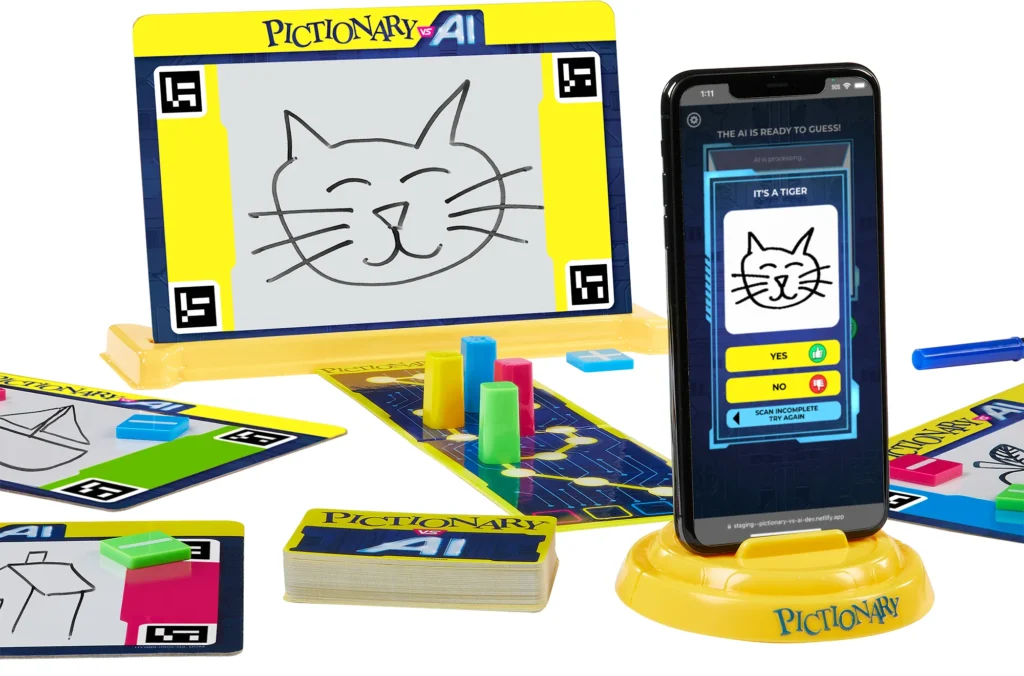
That turns out to be a harder design problem than “make the AI accurate.” An opponent that
guesses correctly every time isn’t fun. Neither is one that’s obviously guessing at random.
The design challenge was never really about the model — it was about pacing the experience so
that losing to the AI, and beating it, both feel earned. The Turk got away with theater for
decades because nobody could see inside the box. We don’t have that luxury, and honestly, I
don’t think we’d want it. The fun of playing against a real AI is that the box is empty. What’s
in there is actually thinking — however narrowly — about your drawing.
Calibrating that degree of accuracy is a matter of “feels right” — something that is, admittedly, more game design art than science.
Lesson: A convincing opponent, human or artificial, isn’t about raw capability. It’s about
calibrating the experience so both winning and losing feel legitimate.
But that’s only one of the design challenges here.
Adding AI to a game like Pictionary risks taking fun away from the players and giving it away to the machine. Pictionary, after all, is about drawing and guessing. And often doing both hilariously wrong. Giving one or the other away entirely is giving away half the fun.
The direction I’m taking with Pictionary vs. AI is to let the AI guess (using computer vision paired with a dataset of drawings)…but only after the players place bets on whether or not the AI will recognize your drawings. Can you recognize my bad drawing? Do you think the AI will? By letting all the players draw as well as place bets on other players’ drawings, everyone stays engaged in the game and, just as importantly, the AI doesn’t take away a fun part of the game from anyone.
And AI guesses can be as hilariously bad as mine, so at least we’re on equal footing.
Update: Pictionary vs. AI was nominated for a Toy of the Year Award!